


Updated: Aug 3

We flew out of Agra battered but grinning, India still ringing in our ears, and touched down in Kathmandu two hours later expecting nothing more than a breather. Three quiet days between India and China. In and out.
Spoiler: Nepal had other plans. Nepal, in fact, had several plans, most of them involving a hotel owner with main character syndrome.
Arrival (29th September): Late Night Vibes and a Very Friendly Hotel Owner
We landed close to 10pm, running on fumes but still buzzing, and checked into a hotel in Thamel, Kathmandu's tourist district and the pulsing heart of its backpacker scene.
The owner was waiting for us at reception, all smiles, and sat us down at an outdoor table despite the late hour. Food at this time of night felt like a small miracle after a day of travel.

Then he sat down. With us. For the entire meal.
Uninvited, unannounced, and not going anywhere.
Back home, a hotel check-in ends with a key and maybe a polite "enjoy your stay." Here, our host settled in for a full conversation: our plans, his suggestions, his tour packages, a friend who could drive us anywhere, another friend offering Mount Everest flights at a "good price." Alan was sold before dessert and handed over his details on the spot, the poor unsuspecting lamb. We thanked our host, explained we already had our three days mapped out and went to bed feeling very pleased with our diplomatic escape.
We had absolutely no idea. This man was just getting started.
Day One (30th September): Bhaktapur, Pashupatinath, and the Monkey Temple

Morning came fast, and so did Bhaktapur Durbar Square, one of three royal cities scattered through the Kathmandu Valley and a UNESCO World Heritage Site in its own right. "City of Devotees," dating back to the 12th century, once the capital of the Malla Kingdom. Every corner held something carved: pagoda roofs, terracotta detail, the 55-Window Palace with its lattice woodwork from 1427, the Golden Gate glinting with images of Hindu deities. Monks drifted past locals going about ordinary mornings, and the whole square hummed with something ancient and calm.
We browsed shops stacked floor to ceiling with mountain gear: North Face knockoffs by the hundred, trekking jackets, waterproofs, all absurdly cheap. Neither of us needed convincing. We left with more layers than sense, already congratulating ourselves on our bargain-hunting skills.
Then we arrived at Pashupatinath Temple, one of the holiest sites in Hinduism, dedicated to Lord Shiva and set along the sacred Bagmati River. The temple complex traces back to 400 AD, though the buildings standing today date from the 17th century. Hindus travel from across the world to reach it. It's also one of Nepal's most significant cremation sites, and this is where the day tipped, hard, from sightseeing into something far heavier.

Open-air cremations were happening along the riverbank as we arrived. In Hindu tradition, cremation releases the soul to continue its journey through reincarnation, and families gather in full view to say goodbye, bodies wrapped in orange or white cloth, laid on wooden pyres, the fire lit while everyone watches.
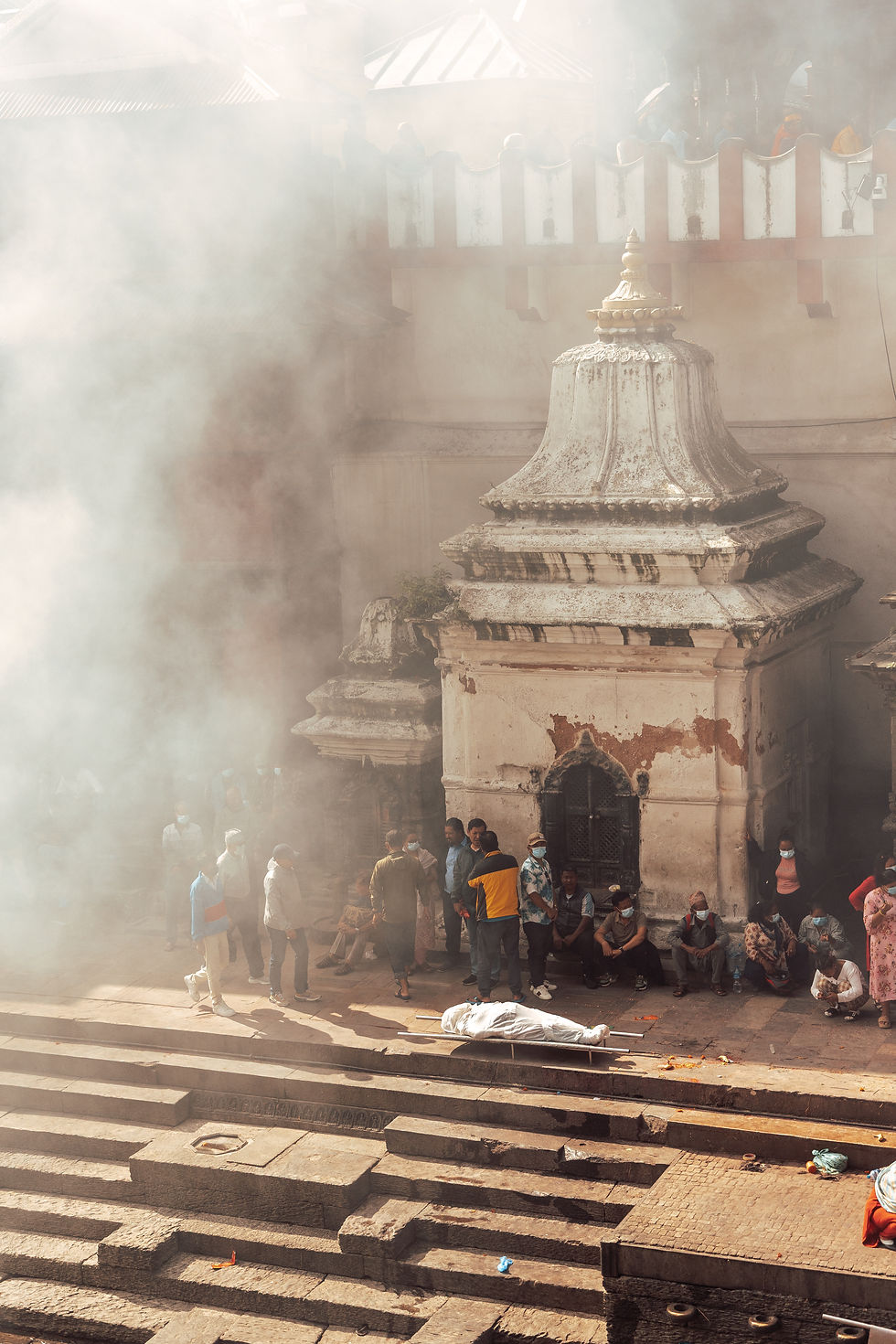
It's confronting in a way nothing had prepared me for. Death, held so openly, so publicly, forces you to sit with how fragile life actually is, and how differently we're taught to grieve back home, tucked behind closed doors and euphemisms.
One ceremony broke something open in me completely. The man being cremated had been a
soldier. Over forty men stood in perfect formation in full military uniform. His mother stood near the fire holding his photograph, her cries cutting straight through the smoke and the noise of the river. I stood there with my camera in my hands, tears running down my face, trying and failing to process the sheer weight of what I was witnessing: the grief, the honour, the raw humanity of it.
We needed somewhere lighter after that, and Swayambhunath, the Monkey Temple, gave us exactly that. One of Nepal's oldest Buddhist stupas, over 2,000 years old, perched above the valley and named for the mischievous residents patrolling its forested slopes. And I mean patrolling. These are not cute, photogenic, harmless monkeys. These are seasoned professionals with a five-star record in bag theft, and they clocked us as tourists before we'd even reached the steps.

The great white dome watches the valley through Buddha's painted eyes on all four sides, prayer flags strung across every available inch, fluttering their mantras out into the wind. We circled clockwise as tradition demands, spinning every prayer wheel we passed, one eye on the mantras and one eye firmly on our bags. From the top, the entire Kathmandu Valley opened up beneath us: rooftops, temples, distant peaks. We sat with tea, letting the whole strange, heavy, beautiful day settle, monkeys watching us the entire time like they were waiting for us to get comfortable enough to drop our guard.
Back at the hotel, our host was waiting again, eager to hear everything, then asked if he could join us for tea that evening.
We explained we'd already eaten.
His smile dropped. Instantly. Like a switch had flipped somewhere behind his eyes, disappointment curdling fast into something closer to irritation. We brushed it off, chalked it up to a long day, and went to bed.
We should not have brushed it off.
Day Two (1st October): Lazy Morning, Everest Disaster, and Chandragiri Hills
Darkon and I allowed ourselves a slow start. Alan was up in the dark, buzzing with nerves for his Mount Everest scenic flight, the one our host's "friend" had sorted at a "good price."
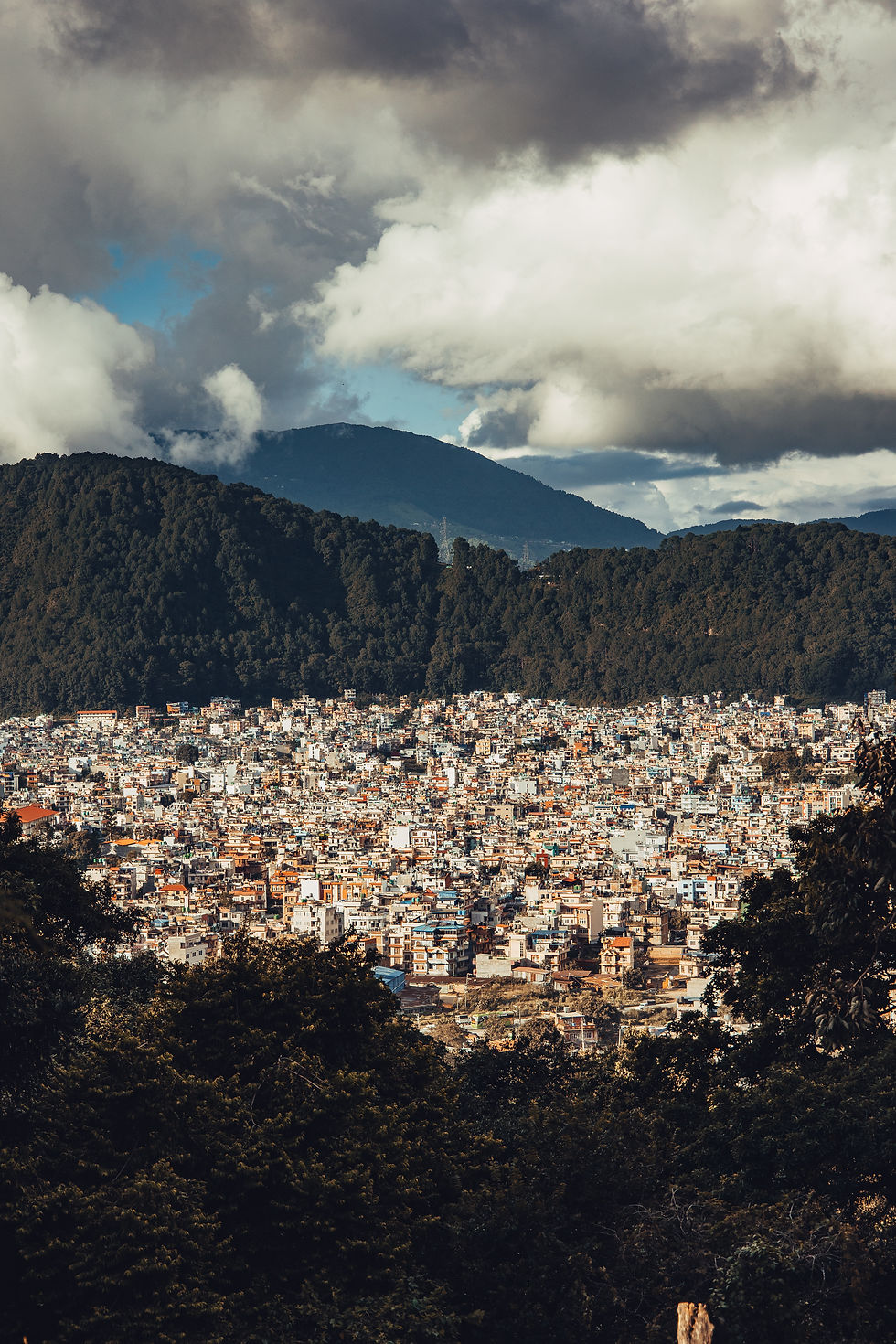
We found a tiny café buried in plants somewhere in Thamel, serving, improbably, a full English breakfast, and spent the morning wandering, hunting for a rainproof coat ahead of China.
When Alan came back, we asked how it went.
Disaster. Full, unfiltered disaster.
His driver never showed. He overslept, arriving an hour late, sprinting through the terminal to make the plane by seconds, boarding pass flapping, dignity nowhere in sight. He'd been promised a "private flight" and charged extra for the privilege. It was not private. Twenty-plus people were crammed aboard like commuters on rush hour, and because he'd arrived late, every single window seat was already taken. The entire reason he'd booked the flight, Mount Everest, the tallest mountain on Earth, sitting right there outside the glass, reduced to glimpses stolen over strangers' shoulders like a man trying to watch a football match through someone else's living room window.

Disappointed doesn't quite cover it. Robbed is closer.
He'd get his real view of Everest eventually. Just not remotely the way anyone expected, and not for another 36 hours.
To salvage the afternoon, we headed for the cable car at Chandragiri Hills. The drive alone nearly finished me off: hairpin bends, sheer drops, cars threading past each other with inches to spare while my knuckles turned white around the door handle. But the cable car climbed us up through drifting cloud and fog, the valley falling away beneath us, and something in my chest finally unclenched.
The peak itself, though, was buried in mist. On a clear day you're meant to see Everest from up there. We saw nothing but white. A running theme for Alan today, and one that was about to get significantly worse before it got better.
The Last Meal and a Very Unhappy Hotel Owner
That evening we treated ourselves to dinner at the Surya Heritage Hotel, a beautiful rooftop restaurant that should, by all accounts, have been perfect.
It was completely empty. Not "quiet." Not "peaceful." Empty in the way a place is empty right before something goes wrong in a horror film. We didn't clock it at the time. We sat reminiscing about Nepal, already planning China, while I worked through a sizzling chicken dish that arrived hissing dramatically on a hot plate. Delicious, I thought. Famous last words, part several.

Back at our hotel, we asked reception to arrange transport for our early flight the next morning.
And then our host appeared.
Furious. Loud. Demanding to know why we hadn't spent money at his restaurant, why we hadn't booked any of his tours. "Why have you gone out to have food and not eat in my hotel, in my restaurant?!" Right there in front of other guests, no attempt whatsoever to lower his voice, playing to an audience he hadn't been invited to perform for.
We tried explaining, gently, that we'd loved his food the first night but wanted to try other restaurants and experience local food as much as we could in our short time. Isn't that the whole point of travelling?
He was not having any of it. Visibly wounded, like we'd personally insulted his ancestors by ordering a chicken sizzler two streets away. We apologised, tried to de-escalate, and eventually just walked away, thoroughly rattled and went to bed thinking about China instead.
We should have known the night wasn't done with us either.
2am: Food Poisoning from Hell
2am. I woke desperate for the bathroom.
Then it hit properly. Both ends, simultaneously, for hours, with a violence I have genuinely never experienced before or since. The chicken sizzler. That eerily empty restaurant. Of course it was the chicken sizzler. It was always going to be the chicken sizzler.

I was curled on the bathroom floor, shaking, sweating through everything I owned, questioning every choice that had led me to this specific tiled floor at this specific hour, thousands of miles away from home. Darkon woke instantly and
knew something was seriously wrong.
He insisted we cancel the flight and try again the next day.
I refused. Point blank. Not even two weeks into the trip, I was not about to let my own digestive system dictate the itinerary. We were sticking to the plan, my body's opinion on the matter be damned.
Morning Departure: Held Hostage for a Google Review
We forced ourselves through checkout, me barely upright, moving more like a haunted marionette than a functioning adult. Our booking included free airport transport. With one small, previously undisclosed condition.
A five-star Google review. First. Before we were allowed to leave.
Given the events of the previous evening, we were not exactly in a five-star mood. But there stood our host, directly beside us at reception, watching every word appear on the screen like a man supervising a hostage negotiation. I was desperately, dramatically unwell. Darkon just wanted me on that plane by any means necessary. So we wrote it. Glowing. Generous. Entirely fictional. While he read along in real time, nodding approvingly at his own five stars.
We changed it the second we left and once we did, we scrolled through other reviews and found the exact same pattern, over and over: demands for money, aggression toward guests who hadn't spent enough, five-star reviews extracted under duress for services that were meant to be included in the first place. A man running a small empire of manufactured praise, one intimidated tourist at a time.
We got our "free" transfer eventually and made it to the airport in a blur: sleep, sprint to the bathroom, repeat, sweat pouring off me, unable to keep anything down. Darkon and Alan practically carried me through security and posted me into my seat like an oversized parcel.
I was unconscious before the plane even left the ground.
Then, somewhere over the Himalayas, i felt a nudge.
"Look out the window," Darkon said.
I reluctantly forced my eyes open.
There it was.
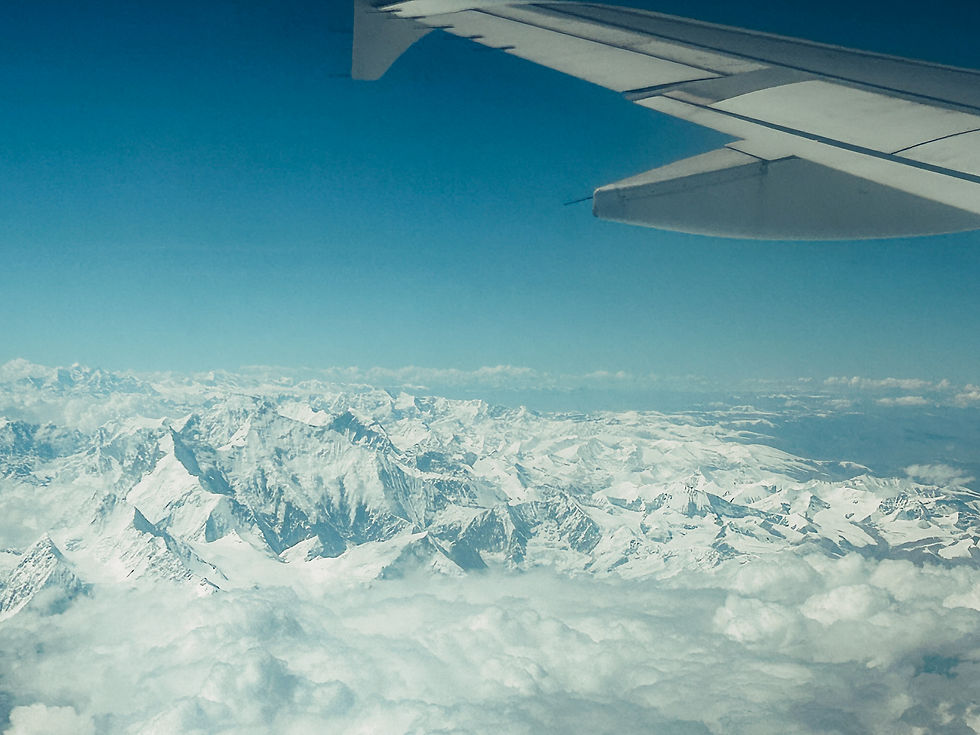
Mount Everest!!! The tallest point on the planet, 8,849 metres of it rising clean above the clouds, the entire Himalayan range stretched out endlessly on either side, snow catching the light like it was on fire.
Alan, who twenty-four hours earlier had watched this exact mountain through the back of a stranger's head, now had a window seat. Unobstructed. Completely free. The universe, it turned out, had a sense of humour after all, and Alan was finally on the receiving end of the joke instead of the punchline.
I smiled, held the view in my mind for exactly as long as my body would allow, and passed out again.
NEPAL HIGHLIGHTS
Things to Do:
Bhaktapur Durbar Square: UNESCO World Heritage Site, ancient Malla Kingdom capital
Pashupatinath Temple: sacred Hindu cremation site on the Bagmati River
Swayambhunath (Monkey Temple): 2,000-year-old Buddhist stupa with panoramic valley views
Thamel: tourist district, endless mountain gear shops and cafes
Chandragiri Hills Cable Car: Himalayan views on a clear day
Cultural Experiences:
Prayer flags and prayer wheels at Buddhist sites
Open-air cremation ceremonies, deeply emotional, approach with respect
Traditional Newari architecture and wood carvings
Meeting monks and sadhus in temple complexes
Best Areas to Stay:
Thamel: the obvious base, backpacker-friendly, walkable, endless food and gear shops nearby
Boudha: quieter, near the Boudhanath stupa, better for a slower pace
Patan: across the river, more local feel, still close to Kathmandu's main sights
Rough Price Guide:
Mount Everest scenic flight: NPR 32,000–44,000 (~£160–220) for foreign tourists. Book directly with the airline (Buddha Air, Yeti Airlines) rather than through a hotel middleman
Budget guesthouse in Thamel: NPR 1,600–3,000/night (~£8–15)
Cable car at Chandragiri Hills: NPR 600–1,000 return (~£3–5)
Mountain gear (jackets, trekking bags): genuinely some of the cheapest in Asia, haggle anyway
Street meal: under NPR 400 (~£2); sit-down restaurant: NPR 800–1,600 (~£4–8)
(Rates fluctuate, worth a quick check closer to travel dates.)
Pro Tips:
Book Everest flights directly, not through hotel owners chasing commission
Bring hand sanitiser. Lots of it. More than you think you need
Cremation sites welcome photography, but stay discreet and respectful
Watch your bags near the monkeys. They will steal anything loose, and they know exactly what they're doing
Never let a host pressure you into writing a review before services are delivered. That's extortion, and it's worth reporting
Check recent reviews carefully before booking. Patterns of bad host behaviour tend to repeat, and someone before you probably already left a warning
A Photographer's Reflection: Nepal's Unexpected Lessons
Nepal was supposed to be a stopover. A breather. Three days, in and out, between India and China.
Instead it became one of the most intense, chaotic, emotionally whiplashing stretches of the entire trip, and somehow all of that fits into just seventy-two hours.
Through the lens, it's an absolute gift: prayer flags bursting colour against ancient stone, Buddha's eyes watching over the valley from every angle, centuries of woodwork still standing in Bhaktapur's quiet squares. But more than any single photograph, Nepal handed me a shift in perspective I didn't expect. Watching grief held so openly at Pashupatinath, where death is treated as part of life's cycle rather than something hidden away, made me think hard about how differently we handle it back home.
And then, of course, there was the food poisoning. A rite of passage for any traveller through Asia, and proof that stubbornness and commitment are sometimes the exact same thing wearing different outfits.
Three days. Beauty, grief, a furious hotel owner extorting five-star reviews, and Everest finally glimpsed through a window while I was barely conscious enough to appreciate it. Chaotic. Overwhelming. Completely, unforgettably ridiculous.
Would I go back? In a heartbeat. Just maybe not to that particular hotel.
Next chapter: China.


Comments