


Updated: Jul 31

Some journeys ease you in gently. India did not.
We landed in New Delhi with Darkon's friend Alan in tow, three of us stepping into a city that seemed to be daring us to keep up. I had my camera ready. I thought I was ready too. I wasn't.
Spoiler: nothing prepares you for India. Not really. Not even the five days that followed, which somehow managed to include a mugging by a six-year-old, a stranger cleaning exactly one of my ears, and an accidental strip club.
Arrival: Traffic, Chaos, and "Welcome to India"
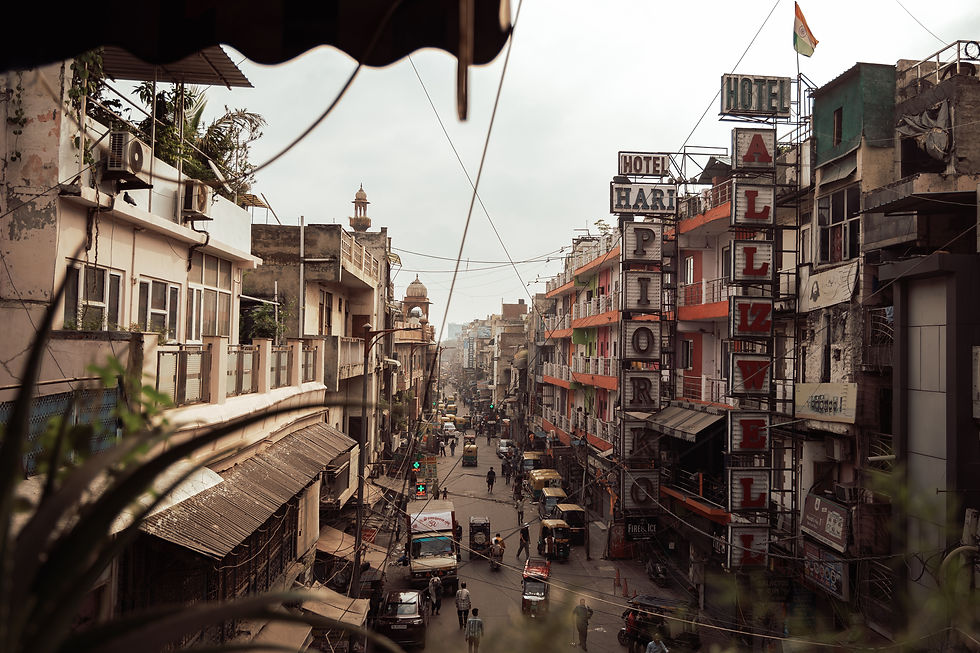
The moment our vehicle pulled away from the airport, I understood. This wasn't traffic. This was a living organism: cars, motorbikes, tuk-tuks, cows, camels, and pedestrians all moving through the same narrow space at once, bound by some invisible agreement that lanes and indicators were more suggestion than rule. Horns blared constantly, not out of anger but as a kind of conversation. Somehow, impossibly, none of it collided. I had no idea how. I still don't.
We dropped our bags down a narrow alleyway off the main road and went straight back out, because that's where we met Paw, a tuk-tuk driver and old friend of Darkon's from a previous trip. The reunion needed no warm-up. Within seconds it was banter, laughter, and a plan.
Food came first. Not fine dining, a small, roaring, elbow-to-elbow restaurant that smelled like everything good in the world at once. We ordered one of everything. Best decision I made all trip.

Day One (25th Sept): The Bracelet Incident, Connaught Place, and an Accidental Strip Club
Paw's tuk-tuk carried us back into the chaos, and it was at a red light that India delivered its first gut-punch. Four children, none older than six, darted between the stopped cars, tapping on windows, palms open. Paw had warned us this would happen, that these children are often sent out by adults, sometimes their own parents, to fund addiction, and that the kindest thing you can do is refuse, so the cycle eventually starves itself out. What he hadn't warned me about was how fast, how relentless, how impossible to shake off they'd be.
Before I registered what was happening, small hands were already inside our tuk-tuk, grabbing at anything within reach. I don't wear flashy jewellery. But I hadn't been able to leave behind one thing: a silver bracelet from my friend Lucy, a St. Christopher charm meant to keep me safe on the road. Beautiful. Irreplaceable. And now the target of a six-year-old's grip.
She found it instantly. Small fingers wound around the beads and pulled. I begged her to let go. She didn't. More hands joined hers, laughing, tugging harder, and I felt the clasp straining against my wrist. There wasn't time to think, only to choose. Let it snap, or take it off myself.
I took it off.
The second it left my hand, they scattered, laughing, vanishing back into the crowd exactly as the light turned green and the traffic surged forward again. The whole thing lasted maybe two minutes. It felt like twenty.
I'd been mugged by a six-year-old. In India. On day one.
Paw apologised over and over, though none of it was his fault, and as gutted as I was to lose Lucy's bracelet, I understood the weight behind it. Those children weren't villains. They were being used. It didn't undo the loss, but it changed the shape of it.
We pressed on to Connaught Place, New Delhi's grand Georgian-era commercial heart, its colonial arcades curling around a central park in perfect concentric circles, a photographer's dream of symmetry. And then, as if the day hadn't already thrown enough at me, the ear cleaning man appeared.
Not a spa treatment. Old-school metal tools, techniques passed down for generations by kaan saaf karnewale, traditional street ear cleaners. Darkon, being Darkon, sat straight down. I watched, half fascinated and half horrified, as chunks of wax the size of I-don't-want-to-know emerged from his ear.
Then the man turned to me. My turn.
He cleaned exactly one ear. Just one. Then stopped, packed up his tools, and moved on, leaving me stood there half-cleaned and completely baffled. Religious? Cultural? I still don't know. Random, though? Absolutely. Unforgettable? Also yes.
Not long after, a wild monkey (a Rhesus macaque, bold as brass) sat eating a stolen sandwich on a busy street corner as if he owned the postcode. My first taste of Asia's wildlife, and if this was only day one, I had no idea what I was in for.

That evening we wandered Ratan Lal Market (Kinari Bazaar), a centuries-old trading hub exploding with neon, noise, and colour, motorbikes weaving through crowds, stalls piled high with wedding decorations and textiles. Bar staff pulled at our sleeves, insisting we come in for a drink. We asked for somewhere quiet. He promised us exactly that.
We should have known better.
The bar was modern, softly lit, pleasant enough, until we noticed the small stage in the corner, and the fact that we were the only people in the room. It dawned on us slowly, then all at once: that stage wasn't for anything innocent.
We'd walked straight into a strip club.
Too early for any show, thankfully, we finished our beers, laughed about it, and called it a night. Day one in India: complete.

Day Two (26th Sept): Red Fort and Rooftop Dining
We met Paw again the next morning for breakfast at a rooftop restaurant that hung directly above the chaos, horns and chatter rising up from the street below while we ate looking out over a city already wide awake.
Then, the Red Fort (Lal Qila). Its red sandstone walls rose up against the noise of the streets like something out of time, built between 1638 and 1648 by Emperor Shah Jahan, the same man behind the Taj Mahal. For nearly two centuries this was the beating heart of Mughal power, and on 15 August 1947, Jawaharlal Nehru stood above its Lahori Gate and raised India's first free flag, a tradition every Prime Minister has repeated ever since.
Inside, the Diwan-i-Khas once held the legendary Peacock Throne. Outside, walls stretching over two kilometres shift from 16 metres high on the river side to 33 on the city side, a fortress built not just to rule, but to dazzle. I spent an age chasing the way sunlight caught the carved sandstone, the ancient stillness of it all a strange contrast to the honking world just beyond its gates.

From there, Paw led us into Chandni Chowk ("Moonlight Square"), a market so old it was designed in the 17th century with canals that once mirrored the moon. We ate kulfi as we wandered, then arrived at the Khari Baoli spice market, Asia's largest wholesale spice bazaar since the 1600s. Pyramids of turmeric and chilli powder stacked shoulder to shoulder, the air so thick with spice it felt like you could taste it just by breathing. I shot everything: the colour, the weathered hands of the traders, the light falling in gold shafts through the canopy above.
Paw wasn't finished with his surprises. A secret rooftop entrance let Darkon fly his drone above the rooftops of Old Delhi, the whole city unfurling beneath us in a way that made my chest tighten.
We visited Humayun's Tomb next, the first garden-tomb ever built on the Indian subcontinent and the direct inspiration for the Taj Mahal itself. Red sandstone inlaid with white and black marble, framed by gardens split into four in reference to the four rivers of paradise. I wandered for hours, trying to catch the light dancing across every inlay.

Our last stop was Hazrat Nizamuddin Dargah, one of India's most significant Sufi shrines, resting place of the saint Nizamuddin Auliya and a centre of qawwali music for over 700 years. The energy here was different, quieter, deeper, threaded with devotion rather than spectacle. Flower sellers and incense vendors lined the narrow approach, and even without staying for the Thursday night qawwali performances, the spiritual pull of the place was unmistakable.
By the time we made it back to Paw's tuk-tuk, Darkon and Alan had both dozed off at various points. I couldn't. My mind was too full.
That evening we returned to the rooftop, this time to thank Paw properly over dinner for two days we wouldn't have experienced without him, the real Delhi, not the postcard one. Early to bed. Tomorrow, we were Agra bound.
NEW DELHI HIGHLIGHTS
Things to Do:
Red Fort (Lal Qila): UNESCO World Heritage Site, Mughal fortress & palace complex
Chandni Chowk: 17th-century market in Old Delhi
Khari Baoli Spice Market: Asia's largest wholesale spice market
Connaught Place: Georgian-style colonial commercial hub
Humayun's Tomb: UNESCO World Heritage Site, inspiration for the Taj Mahal
Hazrat Nizamuddin Dargah: Sufi shrine, centre of qawwali music
Traditional ear cleaning experience (kaan saaf karnewale): if you're brave enough
Best Areas to Stay:
Paharganj: budget backpacker hub, walkable to New Delhi railway station
Connaught Place: central, well-connected, more mid-range hotels
Karol Bagh: good mid-range value, close to metro
Rough Price Guide:
Red Fort entry: around ₹500–600 for foreign tourists (~£4–5); ₹35 for Indian nationals
Budget guesthouse: roughly £8–15/night; mid-range hotel: £25–50/night
Street food meal: under £2; sit-down restaurant meal: £5–10
Tuk-tuk rides: always agree the price first: a short hop should run £1–2
(Prices shift fast in India, worth a quick check closer to your travel dates.)
Day Three (27th Sept): Agra Bound and Agra Fort
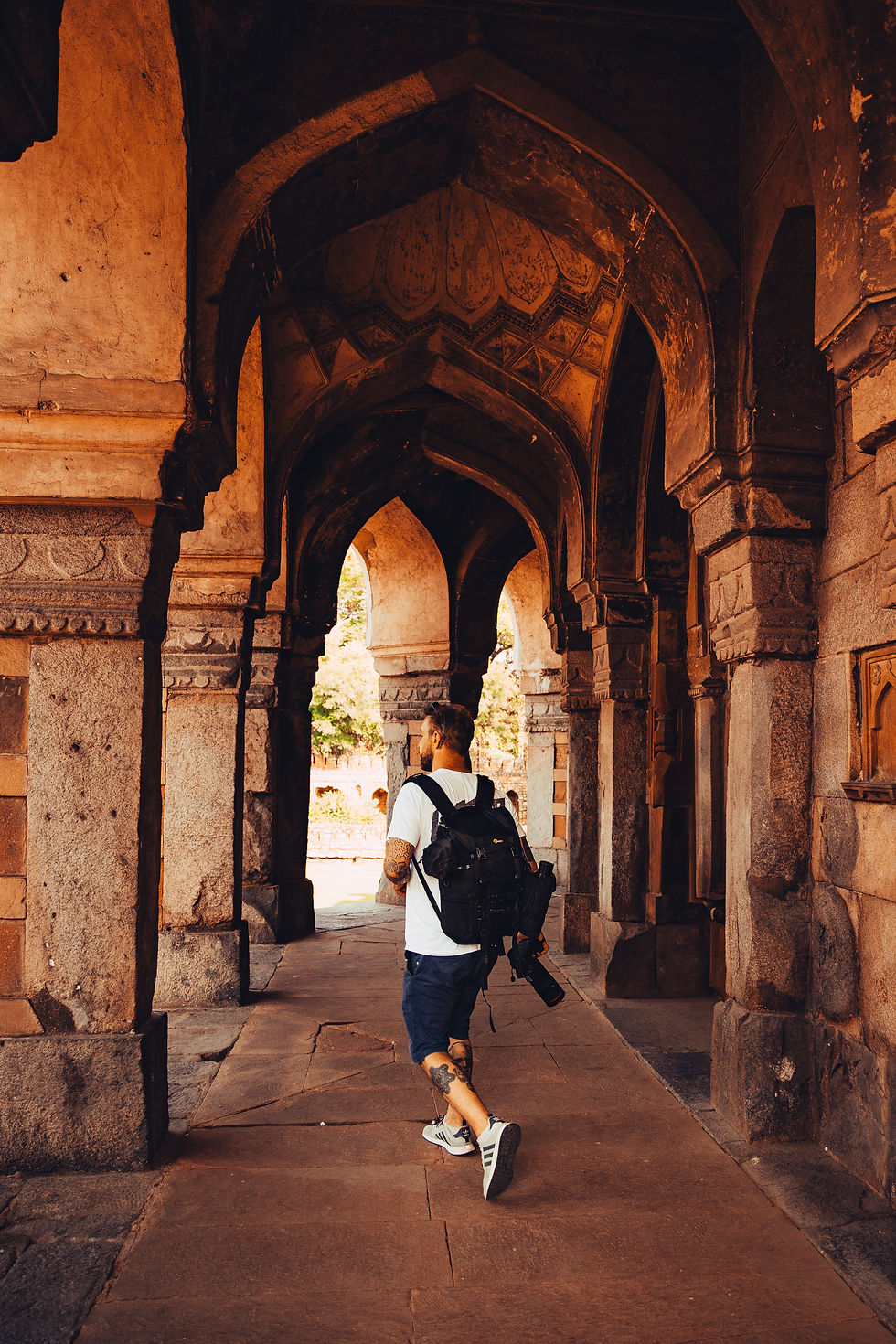
We said goodbye to Paw on the morning of the 27th and set off for Agra, the drive long but charged with anticipation.
Agra Fort met us first, easy to confuse with Delhi's Red Fort by name alone, but an entirely different beast. Built in 1565 by Emperor Akbar, this walled city sprawls across 94 acres behind walls 70 feet high, its red sandstone halls holding the Jahangir Palace, the mirror-lined Sheesh Mahal, and the Diwan-i-Khas where the Peacock Throne once sat before it moved to Delhi.
There's a darker thread running through this fort too. Shah Jahan, the man who built the Taj Mahal for his beloved wife, was imprisoned here by his own son. He spent his final eight years confined to the Musamman Burj, a tower with one cruel mercy: a clear view across the river to the monument he'd built for her. Imagine creating the most beautiful tribute to love in human history, then spending your last breath staring at it from a cage.
I lingered on the small things, the carved jalis that let in light while keeping privacy intact, the view over the Yamuna, the stone changing colour as the sun crept across the sky.

Day Four: A Room with a (Taj Mahal) View
Our accommodation had a rooftop bar with a direct line of sight to the Taj Mahal across the water. What a way to arrive.
That evening we headed to a spot Darkon had already scouted, hoping for a blazing sunset behind the monument. We got blues instead of oranges, still beautiful, just not the drama we'd pictured. A local family nearby was struggling to fit everyone into a selfie, so we offered to take it for them, and their faces lit up brighter than any sunset would have.
Then a young videographer approached, practising for wedding work, and asked to film me and Darkon with the Taj behind us. We agreed on one condition: no cheesy poses.
Famous last words.
He was brilliant at directing, and it was far, far too cheesy for either of us to keep a straight face. We laughed through the whole thing, exchanged Instagrams, and somehow the footage came out looking genuinely good.
Dinner that night was on the rooftop, the owner opening the entire space just for the three of us with a dedicated waiter standing by, refusing to leave even when we insisted he didn't need to. It felt far too posh for people like us. We weren't complaining.

Day Five (28th Sept): The Taj Mahal at Sunrise (and a Sketchy Souvenir Shop)
This was the reason we'd come to Agra.
5am alarms. Stumbling out into darkness. Gates by 6am, chasing the promise of thinner crowds and softer light. Our guide wasn't exaggerating about either.
The moment we passed through those gates and the Taj Mahal emerged, glowing gold in the first light of day, I understood every early alarm clock that's ever gone off for this view. The white marble seemed lit from within, the reflecting pools doubling the whole structure in perfect stillness, and for one long moment the entire world seemed to hold its breath.

Built between 1632 and 1653 by Shah Jahan for his wife Mumtaz Mahal, who died in childbirth, the Taj took 22 years and 20,000 artisans from across three empires to complete. The marble itself shifts colour through the day: soft pink at dawn, blinding white by afternoon, gold at dusk, almost translucent under moonlight. A deliberate mirror, Shah Jahan intended, for the changing moods of the woman he built it for.
Up close, 28 types of semi-precious stone are inlaid into the marble in florals so precise they're botanically accurate. Our guide, mid-tour, decided he had opinions about how I should be photographed rather than photographing, and suddenly I was the subject instead of the one behind the lens, directed into poses I'd usually roll my eyes at, standing at that clichéd spot on the walkway, framed by the long reflecting pool and its cypress trees. Cliché or not, standing there with that building in front of me, I understood exactly why everyone takes that same shot.
Inside, our guide produced a small torch and ran it across the marble walls, and I watched the stone shift through soft pinks, warm golds, and pale greens depending on the angle, craftsmanship you simply cannot appreciate until you see it lit like that, inches from your face.
Then, on the way out, he said something that should have set off alarm bells: "I want to take you to a souvenir shop. Won't take long."
Famous last words. Again.

"Around the corner" became down an alleyway. Not a nice one, boarded up, abandoned-looking, the kind of place that makes you recalculate every decision that led you there. Our guide kept repeating "won't be long, won't be long" like a mantra, and then there was human faeces on the pavement, and shuttered shopfronts that hadn't opened in years, and I exchanged a look with Darkon and Alan that said everything: this feels wrong.
The "shop" was locked. Our guide knocked. We sat on a bench, waiting, while Darkon's phone rang over and over, our actual tuk-tuk driver, increasingly furious, threatening to leave without us.
Then a man appeared from the back of the building, and my heart rate spiked before I even knew what for.
Marble sculptures. Genuinely beautiful, hand-carved, skilled work, and eye-wateringly expensive for what they were. He was persistent, we were anxious, and our phones wouldn't stop buzzing. We bought something small just to escape and sprinted back to our fuming driver.
One minute I'd been photographing one of the great wonders of the world at sunrise. The next I was being led down a faeces-strewn alley to a locked marble shop by a man who may or may not have been holding us hostage.
India, you absolute wild card.
Later That Day: Sikandra and Akbar's Tomb
After that rollercoaster of a morning, we returned to the hotel to breathe.
In the afternoon we visited Akbar's Tomb in Sikandra, the resting place of Emperor Akbar, one of the greatest rulers in Indian history, begun by Akbar himself in 1600 and finished by his son Jahangir in 1613. Red sandstone and white marble blend Hindu, Christian, Islamic, Buddhist, and Jain architectural elements, a physical monument to Akbar's own religious tolerance, set within a 119-acre Mughal garden.
After the chaos of the morning, this place felt almost meditative, just me, my camera, and centuries of quiet history. Bliss, in every sense of the word. As I stood at the entrance, obsessed with fitting every inch of the building into frame that I forgot the golden rule of photography: know what's behind you. One step back, then another, eyes glued to the viewfinder, and the ground simply... vanished. I went down like a felled tree, straight into a bush, camera clutched above my head the entire way like I was rescuing a baby from a burning building. Priorities.
AGRA HIGHLIGHTS
Things to Do:
Taj Mahal: UNESCO World Heritage Site, one of the Seven Wonders of the World
Agra Fort: UNESCO World Heritage Site, Mughal fortress & former imperial residence
Akbar's Tomb (Sikandra): mausoleum blending five architectural traditions
Sunset views of the Taj Mahal from across the river
Best Areas to Stay:
Taj Ganj: right by the eastern gate, budget guesthouses, some with rooftop Taj views
Fatehabad Road: mid-range and higher-end hotels, still close to the monument
Sadar Bazaar: a bit further out, better value, more local feel
Rough Price Guide:
Taj Mahal entry: ₹1,100–1,300 for foreign tourists (~£9–10), plus ₹200 for the inner mausoleum (~£1.50); ₹50 for Indian nationals
Agra Fort entry: roughly ₹650 for foreign tourists (~£5)
Guesthouse with a Taj view: £15–30/night
Licensed guide: a flat fee around £15–18 for a small group (skip the "free" touts near the gate)
Closed every Friday: plan around it
A word of caution: if a guide offers to take you to a "quick" souvenir shop after your tour, know what you're walking into before you say yes.
29th September: Next Stop, Nepal
The next morning we flew out, five days of India already feeling like five different lifetimes. That's a story for another post.
A Photographer's Paradise: The Madness and Magic of India
Looking back at my camera roll from those five days, I'm still stunned by the sheer range of what I captured. India is glorious madness for a photographer: every street corner, every monument, every market stall offering something worth chasing.
It didn't just challenge me. It rewired how I see. There's no time to overthink when a monkey's stealing lunch off a stranger's plate, or when perfect light hits ancient marble for exactly three minutes before it's gone forever. You shoot, and you hope you caught the magic.
I loved every chaotic, beautiful, overwhelming second of it.


Comments