


Updated: Aug 1

After the madness of India and the chaos of Nepal (and that horrific food poisoning), we flew from Kathmandu to China on 2nd October 2024. Just me, Darkon, and Alan, about to embark on what would become the longest, most intense, and most transformative leg of our entire journey.
This is Part 1 of our 22-day China adventure: Chengdu & Chongqing (2nd to 8th October). Spoiler: one of us was about to get diagnosed with salmonella in a foreign country, so buckle up.
Chengdu (2nd to 6th October): Landing in the future with pandas
When we landed in Chengdu, our first stop in China, it was like stepping into the future.

The sheer efficiency and cleanliness of everything, from the airport to the streets, left me in awe. Public toilets were everywhere, sparkling clean, and equipped with buttons for various functions I did not have the strength to investigate given my current condition. It was a stark contrast to the places we'd been, and I couldn't help but feel like we'd entered a world so far ahead of our own.
Our accommodation was surrounded by skyscrapers and buildings lit up by lights like I'd never seen before. The city glowed. I, on the other hand, did not glow. I shuffled.
Day One (3rd October): Pandas & the Leshan Giant Buddha

Our first full day in Chengdu was a dream for any wildlife lover, food poisoning notwithstanding.
We joined a guided tour to the Chengdu Research Base of Giant Panda Breeding, and let me tell you, the obsession with pandas is 100% justified. Watching them lazily munch on bamboo, tumbling around like oversized teddy bears with absolutely zero sense of urgency about anything, I couldn't stop snapping photos. I envied their lifestyle enormously. They're impossibly cute, and it was heartwarming to see the efforts being made to protect these gentle creatures.
Later that day, our guide took us to the Leshan Giant Buddha, an ancient marvel carved directly into a cliff face.

The Buddha stands at 71 metres tall (taller than a 20-storey building) and has been watching over the meeting of three rivers for over 1,300 years. Built during the Tang Dynasty (713 to 803 AD), it's said that the sheer size of the statue was intended to calm the turbulent waters below. It's the largest stone Buddha statue in the world.
What struck me most wasn't just the grandeur of the statue, but the incredible detail. Each curl of hair on its head, and there are 1,021 of them, someone actually counted, the expression of serene wisdom on its face. It was a humbling experience to stand before it, dwarfed by its scale and significance, and also dwarfed by how much better this ancient stone monument was coping with existence than I currently was.
Day Two (4th October): Tianfu Square & The Alien Stares
We spent the day wandering around Tianfu Square, the heart of Chengdu. The square is massive, surrounded by shopping malls, LED screens, and that iconic giant Mao Zedong statue standing tall in the centre.
Chengdu's skyline is a photographer's paradise. Towering skyscrapers reflecting the city lights at night, the contrast between the modern cityscape and the traditional temples scattered throughout was fascinating.
Something I wasn't prepared for in Chengdu was how isolated we felt as Westerners. During our four days in the city, we didn't see a single other foreigner. The locals' stares, while curious rather than hostile, made us feel like aliens who had just landed. It was a strange, humbling sensation that added to the uniqueness of our time there. I like to imagine we were, at minimum, the most interesting thing to happen to several people's Tuesday.

One evening, we wandered into an arcade, something we hadn't planned but couldn't resist. A few games in, we found ourselves with an embarrassing haul of teddies, far more than three grown adults with limited backpack space had any business winning. With no space left to carry them, we decided to gift them to local children, whose smiles made the night even more memorable, and gave our questionable arcade skills a much better ending than they deserved.
Day Three (5th October): Exploring Chongqing & A Trip to the Hospital
Although still battling severe food poisoning and unable to keep anything down, the smells from the street food stalls were getting the better of me. A cruel form of torture, being surrounded by incredible food while your body stages a full mutiny against the very concept of eating.
We caught the train from Chengdu to Chongqing (our next destination), and let me tell you, this was no ordinary train station. It felt more like an airport, with its massive halls, high-tech ticketing systems, and swarms of people moving with purpose. China's infrastructure truly blew me away. The train itself was sleek and modern, speeding through the countryside with incredible efficiency, which felt almost personally insulting given how not-sleek-and-modern I currently felt.
A Note on Chinese Apps
It took us some time to get our heads around all the Chinese apps that were required for this trip.
No UK apps work here. No Google. No regular maps. No Facebook or Instagram. All had to be Chinese apps. No cash either. Everything is paid via QR codes on Alipay or WeChat.
If you're visiting China for the first time, downloading WeChat is an absolute must. It's not just for messages, it's used for taxis, translation, payments, even directions. It became our travel lifeline.
CHENGDU HIGHLIGHTS
Things to Do:
Chengdu Research Base of Giant Panda Breeding
Leshan Giant Buddha: 71m tall, Tang Dynasty, UNESCO World Heritage Site
Tianfu Square
Modern skyline photography
Arcade gaming, bring spare backpack space for the inevitable teddy haul
Best Areas to Stay:
Chunxi Road / Taikoo Li: central, glowing at night, endless food and shopping nearby
Jinjiang District: mix of modern and traditional, walkable to Tianfu Square
Near the train station: practical if you're heading onward to Chongqing or Leshan
Rough Price Guide:
Panda Base entry: ¥55 (~£6)
Leshan Giant Buddha entry: ¥80 (~£8.50)
Optional shuttle bus inside Panda Base: ¥30 (~£3)
Budget guesthouse: ¥150–250/night (~£16–27); mid-range hotel: ¥400–700/night (~£43–75)
Street food meal: ¥15–25 (~£1.50–2.50); sit-down restaurant: ¥50–100 (~£5–11)
Didi (China's Uber) from downtown to Panda Base: roughly ¥80–120 round trip (~£8.50–13)

Chongqing (6th to 8th October): Salmonella, Pearls & A City That Glows
Arrival: Skyscrapers & Serious Illness
Arriving in Chongqing felt like stepping into a sci-fi movie.
From the window of our hotel, the skyline stretched endlessly. Skyscrapers standing tall and proud, their lights shifting colours as night fell. It was mesmerising, and I knew right away this city would offer plenty of photographic opportunities, assuming I lived long enough to photograph any of them.
We spent the evening walking around Guanyin Bridge, finding local restaurants and trying traditional dishes.
But by this point, I was getting weaker. Struggling to walk. The food poisoning from Nepal hadn't gone away. It had gotten worse. Considerably worse. The kind of worse that stops being a funny travel anecdote and starts being a genuine concern.
Day One (6th October): Morning Yoga & Ciqikou Ancient Town

We woke to see people outside in the street doing some type of yoga, moving gracefully to inspirational traditional Chinese music in the background. It was such a peaceful, beautiful start to the day, and I watched it from a horizontal position feeling roughly nine hundred years old.
We headed for Ciqikou Ancient Town, a 1,000-year-old riverside town famous for its traditional architecture, teahouses, and street food.
During the Ming and Qing dynasties, Ciqikou was a thriving port town where merchants would gather to trade goods along the Jialing River. Today, it's a beautifully preserved slice of old China, with narrow cobbled streets, wooden buildings, and the smell of roasting sweet potatoes filling the air, an air I could smell but very much could not partake in.

We visited a cat café (saw my first Maine Coon and became instantly, completely obsessed), played Chinese games at small stalls, and I watched everyone else eat roast potatoes with the most incredible flavours. Crispy on the outside, soft on the inside, perfectly spiced. Honestly, apparently the best anyone had ever had. I wouldn't know. I was surviving on willpower and the occasional sip of water.

Darkon found a stall with a "pick your own pearls" setup. You choose a clam, they open it, and whatever pearls are inside become a souvenir on the spot. I chose a bracelet.
When Darkon opened his clam, there were over 20 pearls inside. We were stunned. I had a beautiful bracelet made from those pearls right there at the stall, and it's now one of my most cherished souvenirs from the entire trip. I still wear it to this day, which is more than I can say for my dignity from this particular week.
The Hospital Visit: Salmonella Diagnosis
But by this point, I was in bad shape. Really bad. Still projectile vomiting, unable to walk properly, getting weaker by the hour, and running dangerously low on the sheer stubbornness that had gotten me this far.
Darkon insisted. Hospital. Now. Not a discussion.
I thought it would be a disaster like the UK. Long waits, chaos, overwhelmed staff, the works. I was so wrong.
We waited for a doctor no longer than 20 minutes. While we waited, we were speaking with a local family using Google Translate. They were terrified that we were using iPhones. At the time, there was a fake craze going around that iPhones were exploding, and Chinese families were creating videos of themselves smashing up iPhones and any Apple technology. This was all fake news, but the people genuinely believed it. It was one of the more surreal conversations I've had while also actively dying of salmonella.
I explained to the doctor I had food poisoning. Straight away, I was getting tested for all sorts. Blood tests, stool samples, the full works.
My results came back: severe salmonella poisoning.
I was lucky I hadn't left it any longer.
I was prescribed multiple antibiotics, all for as little as ¥190 (roughly £20). I was in and out of the hospital within a couple of hours.
We would never receive this type of service in the UK, considering China has 10 million more people than the UK. Everything just flows and works here. I walked out of that hospital more impressed with Chinese healthcare than I've ever been with anything back home, which says a great deal about both countries.
Off I went from the hospital, straight to a relaxed evening at the hotel and a well-earned takeaway ordered by someone else, because I was still not to be trusted near a menu.
Day Two (7th October): A Train Through a Building
Our first adventure in Chongqing, now that I was finally on antibiotics and starting to feel vaguely human again, was visiting Liziba Station, famous for the monorail that runs directly through a residential building.
It's not every day you see a train glide seamlessly through someone's home. Built in 2004, the design was born out of necessity in a city where space is scarce, and it's now an iconic example of Chongqing's innovation. Hearing the train pass by while the building remained oddly peaceful was fascinating, and surprisingly quiet.

Later, we wandered around the area near our hotel, soaking in the city's energy. The streets buzzed with life, every corner filled with food stalls, neon lights, and the hum of people going about their day.
That evening, we scouted a location with a view of Chongqing's famous bridge. We found a beautiful restaurant overlooking the city, waited for it to get dark, and watched as the city and bridge lit up.

Absolutely magical. Here we met a lovely young couple who didn't speak much English (we'd learned by now that English isn't widely spoken here, unlike most places we'd travelled), but we still managed full conversa-
tions through translation apps. I snapped some photos of the couple with the stunning landscape behind them and sent them over on WeChat once I'd edited them. They were thrilled.
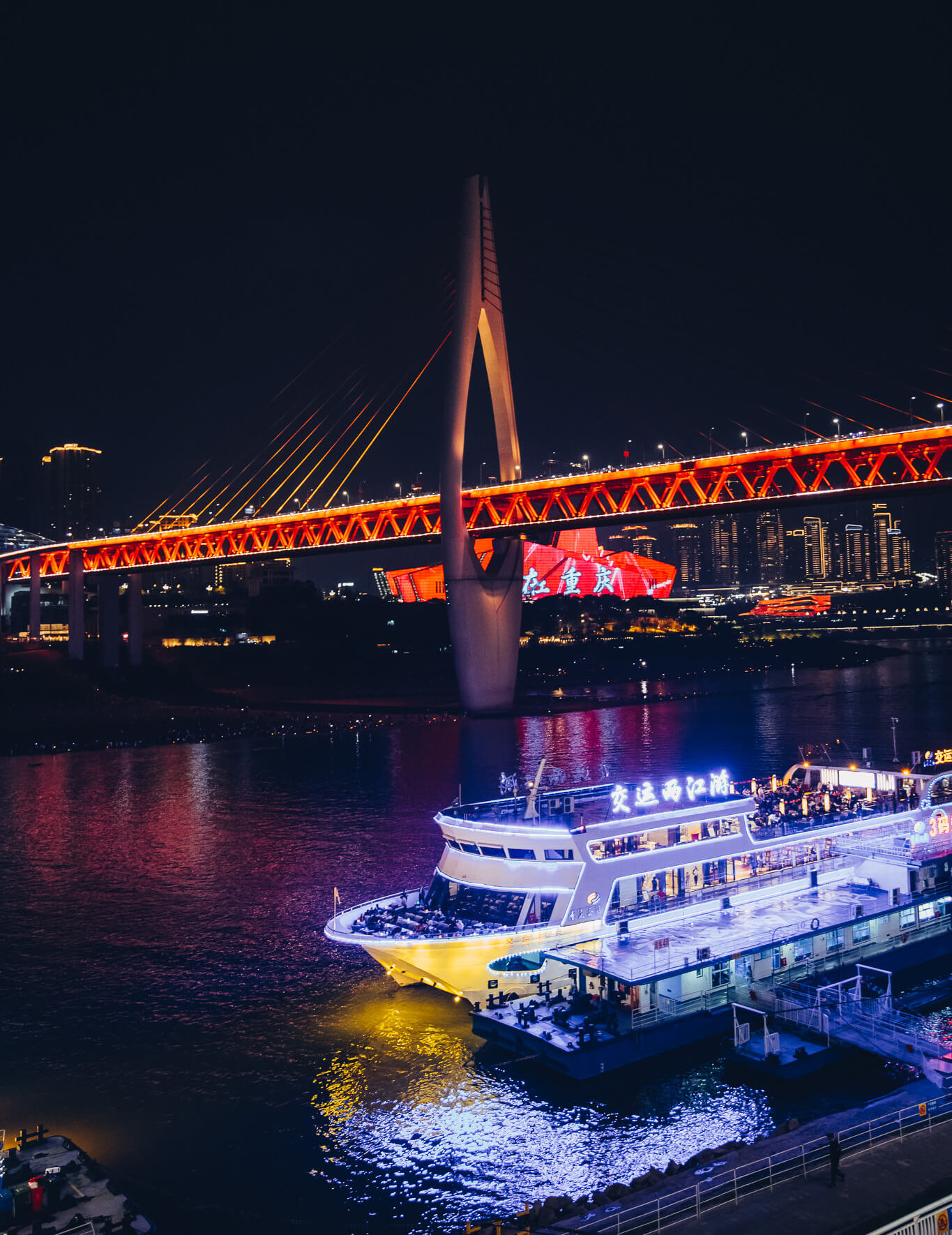
Shortly after, a newlywed couple arrived with a photographer for their own photoshoot at the same spot. Watching a professional photographer coax two people into increasingly elaborate poses is always entertaining, and as a wedding photographer myself, I'll admit it wasn't remotely my style. Fascinating to watch, though. I'd have loved to see how the final shots turned out.
As the night went on, we travelled to Hongya Cave, one of Chongqing's most famous landmarks. Built along the cliffs of the Yangtze River, it's a multi-level complex filled with restaurants, shops, and traditional architecture that lights up beautifully at night.
What we weren't expecting were the crowds.
Hundreds and hundreds of people all trying to get the same photos, vendors with microphones shouting to get your attention. It was all too much. Sensory overload and anxiety kicked in fast. We took a single, hurried photo (not even a selfie), called a Grab taxi, and retreated straight back to the hotel like the whole thing had personally offended us.

CHONGQING HIGHLIGHTS
Things to Do:
Liziba Station: the famous train-through-a-building monorail
Ciqikou Ancient Town: 1,000-year-old riverside town
Cat café (Maine Coon sightings guaranteed to derail your afternoon)
Pick-your-own-pearls stall experience
Guanyin Bridge area for food and evening wandering
Hongya Cave, prepare for serious crowds, especially at night
Best Areas to Stay:
Jiefangbei / Guanyin Bridge: central, glowing skyline views, endless restaurants
Ciqikou area: quieter, closer to the old town, good if you want an early start there
Near the Yangtze River bridges: best for those hunting the skyline photography shots
Rough Price Guide:
Hospital visit with antibiotics (if you need it): around ¥190 (~£20), astonishingly efficient and affordable
Pick-your-own-pearl clam experience: typically ¥50–150 (~£5–16) depending on the stall
Roast potato street snack: a couple of yuan, essentially free
Budget guesthouse: ¥150–250/night (~£16–27); mid-range hotel: ¥400–700/night (~£43–75)
Grab/Didi taxi across the city: ¥15–40 (~£1.50–4)
Pro Tips:
Download WeChat before arriving. Not optional
Alipay and/or WeChat Pay for all transactions, cash is barely accepted anywhere
Hospital care in China is surprisingly efficient and affordable, don't hesitate if something's seriously wrong
Don't trust Instagram photos blindly (looking at you, certain "hidden gem" locations)
The iPhone explosion scare was fake news, but plenty of locals believed it at the time
Bring basic antibiotics or at least know where your nearest hospital is, just in case
Everything local is insanely cheap: supermarkets, vendors, transport, all of it
A Photographer's Reflection: Recovery & Resilience
Chengdu and Chongqing taught me about resilience, whether I wanted the lesson or not.
Landing in China while battling salmonella poisoning, getting diagnosed in a foreign hospital, slowly recovering over the course of these first days. It was challenging, exhausting, and at times genuinely scary. Not exactly the glamorous start to China I'd pictured.
But it also showed me the kindness of strangers (the local family at the hospital, the sheer efficiency of Chinese healthcare), and reminded me that even when you're at your lowest, quite literally curled up in a foreign hospital bed, there are still moments of beauty worth capturing. The pandas. The Giant Buddha. The glowing skyline. The pearl bracelet I still wear today, a small, sparkly reminder that even the worst weeks produce something worth keeping.
From a photography perspective, Chengdu and Chongqing offered incredible contrasts. Ancient monuments and futuristic cities, traditional teahouses and neon-lit bridges. Every frame told a story, even the ones I took between bouts of feeling like death.
Would I go back? Absolutely. Ideally with a fully functioning digestive system next time.
Next: China Part 2, Zhangjiajie (the Avatar Mountains).


Comments